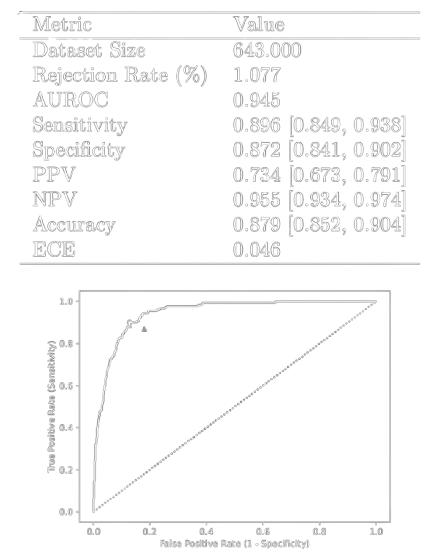
Internally studied performance of iCardio.ai CardioVision™
iCardio.ai CardioVision™ uses deep learning to predict aortic stenosis without explicitly measuring any variable, relying on deep learning. (Wessler, Benjamin S., et al. "Automated detection of aortic stenosis using machine learning." Journal of the American Society of Echocardiography 36.4 (2023): 411-420.)
Aortic stenosis (AS) is a progressive disease associated with important morbidity and mortality.[1] Prior observational studies have demonstrated a significant decrease in survival with AS, especially when the aortic valve obstruction is deemed severe.[2] Recently, observational data have suggested that untreated moderate AS is also associated with poor prognosis.[3,4,5] Unfortunately, the only therapy available for treatment of aortic stenosis is a valve replacement.[6]
[1] Généreux, Philippe, et al. “The mortality burden of untreated aortic stenosis.” Journal of the American College of Cardiology 82.22 (2023): 2101-2109.
[2] Otto C.M., Burwash I.G., Legget M.E., et al. “Prospective study of asymptomatic valvular aortic stenosis. Clinical, echocardiographic, and exercise predictors of outcome”. Circulation . 1997;95:2262-2270.
[3] Strange G., Stewart S., Celermajer D., et al. “Poor long-term survival in patients with moderate aortic stenosis”. JAm Coll Cardiol . 2019;74:1851-1863.
[4] Coisne A., Scotti A., Latib A., et al. “Impact of moderate aortic stenosis on long-term clinical outcomes: a systematic review and meta-analysis”. J Am Coll Cardiol Intv . 2022;15:1664-1674.
[5] Khan K.R., Khan O.A., Chen C., et al. “Impact of moderate aortic stenosis in patients with heart failure with reduced ejection fraction”. J Am Coll Cardiol . 2023;81:1235-1244.
[6]. Lindman, Brian R., et al. "Evaluating medical therapy for calcific aortic stenosis: JACC state-of-the-art review." Journal of the American College of Cardiology 78.23 (2021): 2354-2376.